Emergency

(content warning: suicide)
Three weeks after he spent a night in the ER, my son told me he had been listening to Smog’s “Feather by Feather,” headphones on, midnight at the hospital, while a team of what sounded like twenty hospital employees worked on a man on the other side of the trauma bay curtain. On our side of the curtain, my son was in a bed and hooked up to monitors and breathing oxygen through a plastic mask. Through the fabric, we heard the man’s name. We heard “gunshot wound to the head, self-inflicted.” We heard a nurse crying in the pocket of space between the two trauma bays. We heard someone who sounded older than the crying nurse reassuring her, another nurse probably, saying things like, “I’ve been there, we all have,” and “You’re doing great.” We heard, “heli en route.” We heard “suction” like on a tv show about emergencies. We heard, “it’s amazing how many people survive these.” We heard the shuffle and clatter of people and instruments subside, and then when I went out into the hall to walk to the bathroom and was able to see into Trauma 2 or whatever it was called. The only person in there was a man cleaning up blood, just like in the Denis Johnson story.
Let me back up. Earlier that night, my son, seventeen, his first day on the job at a restaurant, one of our favorites in town, had suffered a partially collapsed lung, spontaneous pneumothorax it’s called. Apparently, this is something that happens to tall, thin teenagers, we’d been told by more than one person in the ER. Only about 20 in 100,000, but enough that people who’d worked in an emergency room setting for more than a few years had stories. The nurse who told us a college basketball player came in with a pneumo every year for many years. A doctor who said he’d just had someone present with a pneumo a few months after a double VATS surgery. “So you just never know,” he said. Another nurse who kept telling my son not to be anxious but that it was possible he could have a heart attack and thus should tell us if he had any shift in the pain he was experiencing. “Don’t worry, though,” he kept saying.
After the gunshot wound, they moved us out of the trauma bay. My son had oxygen, had two IVs, the standard blood pressure cuff that kept pulsing on and jarring us from that hospital half-sleep at 2:15 AM and 3:00 AM, at which point they moved us from the second ER room up to the third floor to a real room that had a plaque at the door, gold and inscribed telling us it was the something something memorial room. I can’t remember the person’s name now.
Spontaneous is a word people tend to use for something fun. This, a small hole in the lung from which air escaped, air that then puddled around the lung itself, compressing it down, a bubble of it settling up against the heart, was not. The common wisdom is that a pneumothorax without needle aspiration, without chest tube, or surgical intervention may resolve on its own. The body can heal the hole in the lung. The air can be reabsorbed by the body. The lung can re-expand, 1-2 mm a day. We computed the rate at which this might occur for him if it did at 20-25 days.
We were only in the hospital for twenty-four hours, not even, but it felt like a week. Hospitals are like that. Apart from time but also wholly dependent on it. There was a lot of should he/shouldn’t he from the doctors about a surgery where they go in through the chest wall, between two ribs, and do something they described as scraping out blisters on the walls of the lung. I texted my friend in the city where my daughter lived, and my friend told me the medical show she’d been watching that night or maybe the previous one had featured someone with a spontaneous pneumothorax. Also, my son and I had been listening to Dinosaur Jr’s “The Lung” on the way to his first day at work, just before this happened. It’s a song we listen to regularly enough that it wasn’t weird, but I couldn’t stop thinking of J. Mascis singing “No way to collapse the lung, breathes a doubt in everyone.”
“Did he die?” my son asked me that night about the man on the other side of the curtain. “No,” I told him. “He didn’t die.”
The weird thing was that my son had been telling me for years that he thought he had a collapsed lung. Some doctor at some point, during some standard doctor visit, had mentioned this as a possibility, had said it could happen, and my son had latched onto it, such that when there was a night when he couldn’t sleep, when he was having trouble, when he had a cold or a cough, he might come into my room and say, “Is it possible I have a collapsed lung,” and I would say, “Absolutely not. That does not just happen.” So many things about parenting were guesswork.
My son is leaving for college in August in a state far from this one. The dorm he will most likely live in is directly across from Mt. Sinai’s ER where a stream of ambulances usher people to the automatic doors for all manner of problems.
A lot of people live with medical issues much more extreme than this. I’ve been trained by my parents in humility above most other pursuits. I’ve been trained to not think my problems are much of anything. To worry but to apologize for the fact of my worrying. It’s likely my son will go to college, have a normal year. It’s also possible he will have a surgery somewhere far from home in a place it takes us a day to get to; the recurrence rates for this are like that. Anywhere from 20% to 50%. In spite of a surprising number of studies, no one can say for sure, which I guess is true of many things.
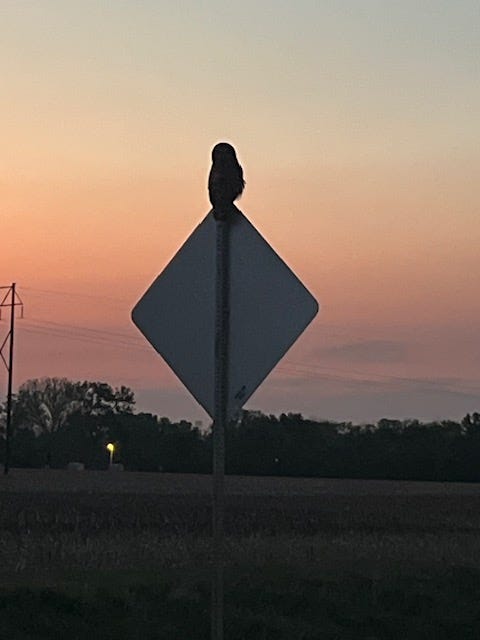
Last night, we drove out in the country, which is something we do. It was those minutes pre-dusk, and we saw something on a sign next to the stretch of tall grass and tangled ash and redbud trees, where there were no houses, only land, where someone had built a deck-like structure to memorialize the death of a loved one. Silk flowers covered the deck railings, and objects probably once important to the person who’d died at that spot, likely after a car accident, were affixed to the wood. The road sign across from it had a bird on it. “A hawk,” my son said when we were maybe the equivalent of half a block away. We were a family perhaps too invested in birds. My son was playing “Feather by Feather.” “This was what I was listening to when they were working on the man in the hospital,” he said. “That was really a hard thing to be right next to,” I said. “It wasn’t as hard as the last three weeks,” he said, a time during which he’d been unable to do almost anything. Had rotted in the house, unable to sing or walk very far or go anywhere. It wasn’t the biggest hardship, but it was getting to him, as was the worry about what he could or couldn’t do in the coming months and years, the uncertainty of it all. When we got closer, we saw that the bird atop the sign wasn’t a hawk but an owl, a small barred owl perched adjacent to the twinkly lights that twisted around the wood railing of the monument to some person I’d always wanted to know something about. We drove past the thing so regularly.
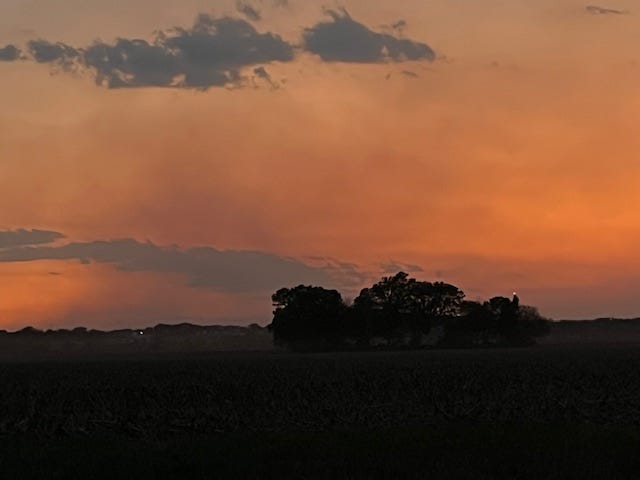
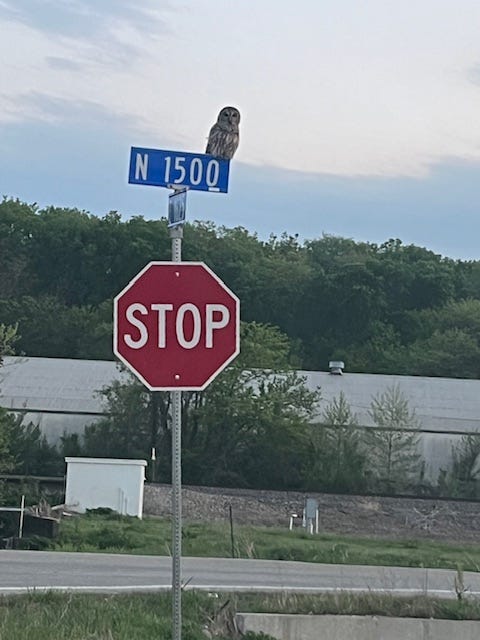
The night was getting darker, and the sky looked watercolored, dusky, thick with pinks and lavenders and peaches. The owl opened its broad wings and swooped into a tree above the wooden deck. We drove around the bend, past the cornfield that was spiked with dusty stalks in April, the place where when the Northern Lights were visible in winter people had parked and watched neon greens and pinks through their phone cameras. We got to the road that bisected that one, and on the stop sign my son said, “Now there’s a hawk.” We slowed to study it, and we saw it was another owl. It turned to look at us. Imploring, I wanted to think, but more likely simply defensive or territorial. I took a picture on my phone, and then it, too, flew away, its wings improbably muscular looking for a bird I knew to weigh maybe a little over a pound.
A year before, a woman had gone missing, someone in her 70s with Alzheimer’s, someone who’d worked at the library and had been full of things to say about books but who, on a day the previous year, had decided she needed to walk east of town, toward family in the city an hour away, where she’d grown up, family no longer even living, I’d read. No one found her, though there had been weeks of walking search parties, and when we drove these gravel roads east of town in the months following her disappearance, I was always waiting to see a body in the little creeks that were partially hidden from view, or catch a flash of her in some collapsing small barn. A skeleton or a bone shining white in the sheared tan stubs of corn stalks. A morbid thought pattern I couldn’t shake, even after a full year. Sometimes, when I saw an owl or a hawk or a deer, startled by the site of us, humans in their space, I’d think her name: Wanda.
A few days after the ER, I heard that the man, a police man, gun shot wound to the head, died at some point after being taken to a larger emergency room in the closest city by helicopter. I found his sister on Facebook, along with pictures of them laughing in the hallway of a house and comments where people were talking about how happy and kind he was. A procession of cars, police and otherwise, stopped traffic across town on the way to or from his funeral, and someone on Facebook complained about it, not knowing what the traffic was, presuming something more mundane.
Amy this is amazing.
Jesus this is incredible, Amy. Beautiful.